Showing posts with label Peter Miller. Show all posts

Monday, September 17, 2012

Peter Miller - my pick of the week...

Joerg Colberg from Conscientious has asked people with photo-blogs (I don't consider myself a blogger, just a photographer who uses a blog for archiving) to begin the week by selecting a photographer or artist who we think is pushing the medium a bit. Being I am in Europe, and Joerg is in NY, my post might be up before he is.

So, my artist this week is the American, living in Köln, Peter Miller. I have followed Peter for years, consider him a good friend, I think he feels the same, so its great timing that he finally has a publication out which fits perfectly into the BUFFET.

A few years ago, as Polaroid was on its way out, I talked to Peter about his work. Here part 1, and here part 2.

Now Peter has a small publication which is actually a box we all know from buying photo-materials; the envelope with the label wrapped around the bottom edge, everyone new not to open it in the light.
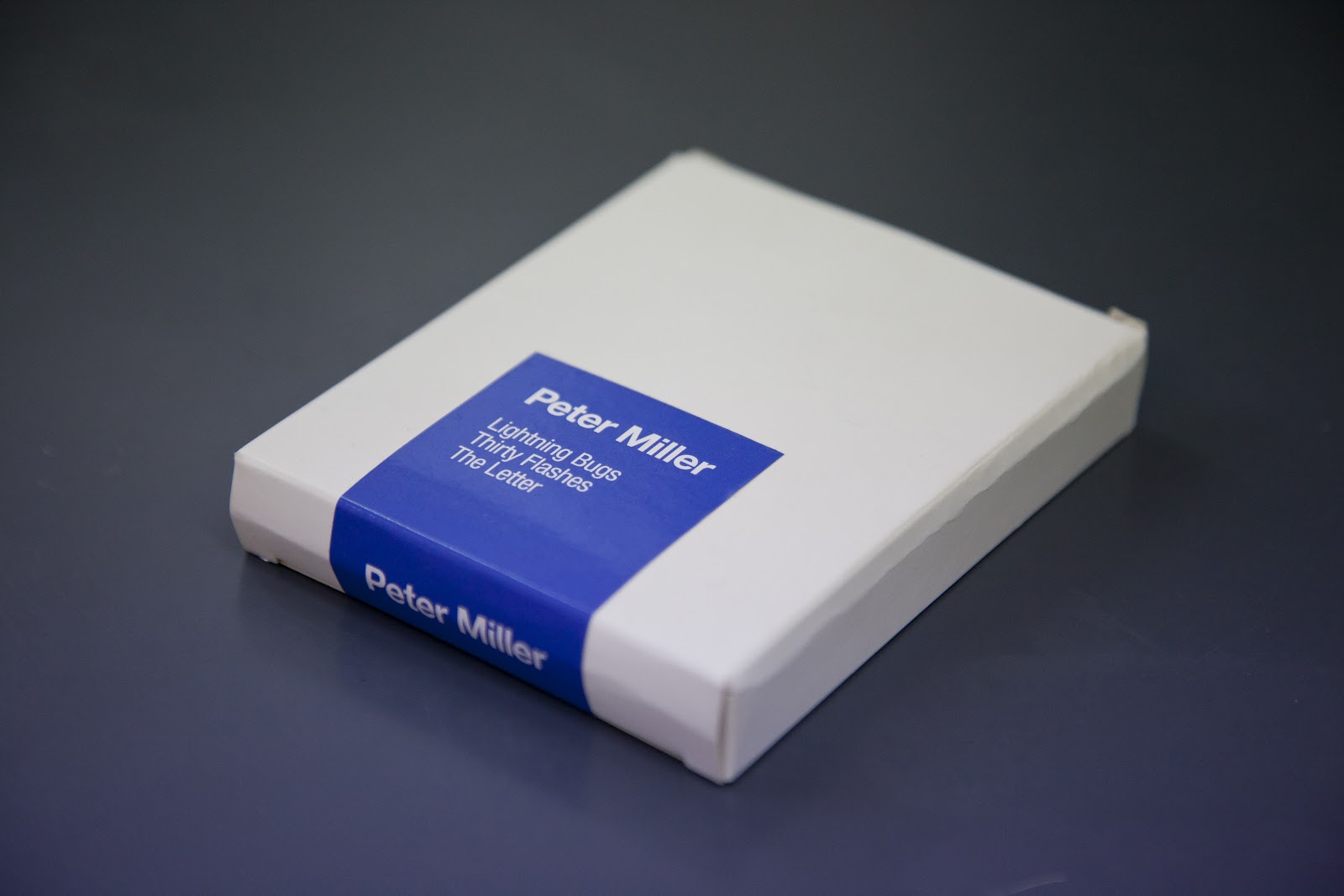


Peter's box contains 3 series which have been compiled in 3 different forms, each reflecting on the work, and the medium, itself


The Letter:


This project is best described in a video of the installation, be sure to watch to the end.


  The Letter from petermiller.info on Vimeo.


Thirty Flashes:


This work is shown in a fold-out poster showing all 30 images. Thirty Flashes consists of 30 8x10 inch gelatin silver prints of a mirror being photographed in a dark room with a flash. The image above the mirror is the reflection of the flash which is exposing the mirror. Its one of those things you shouldn't try to think too hard about...

Lightning Bugs:

The Lightning Bugs are 16 Polaroids which were exposed by fire-flies which peter trapped in the basement with unexposed Polaroid sheets lying on the floor.


When I first met Peter, I think he considered himself as much magician as artist, and he told me once that he turned a cold shoulder to magic due to the fact when stumped by a clever magic trick, everyone would ask "how did you do it?" instead of just simply being mystified for a few moments. With his photography I think he pulls back the metaphorical curtain and we see the wizard, but are still a bit mystified, which is even better.

The little box/book is a product of Peter's work with the Kunsthochschule für Medien in Köln.
ISBN 978-3-942154-11-6

It was published on the occasion of his show in the Glasmoog Gallery in Cologne in 2010.

Try to get them through Peter.


Monday, December 14, 2009

Peter Miller - Solo at Glassmoog, Cologne


Peter Miller, whose work I have talked about numerous times at cocktail parties and when I need to wow someone with brilliant, mystical and magical anecdotes, has just launched what I think to be his first significant solo show in Cologne, Germany.

If you can't make it to the show, as neither could I, you can see a few of the pieces here:

http://www.petermiller.info/glassmoog.html


"Haley's Lightbulb" and "What's killing me is what's keeping me alive" are 2 highlights.


Filzengraben 2a

50676 Cologne, Germany


Show runs from the 5th of December until the 23rd of January, 2010.

Viewing hours are Thursday through Saturday, 16-20 o'clock.

Artist talk with Vesko Gösel on Thursday, January 21st 2010 at 19 o'clock.


Tuesday, January 13, 2009

Peter Miller - On Polaroid (part 2)

This is the 2nd part of the previous post.

The altar of objecthood

Jumping to the other side of justice, I understand that the only type of photograph that cannot be mailed to a US prisoner is a Polaroid, for something could be hidden inside of it. It is this status of the Polaroid as an object that functions to substantiate the claim that whatever image it contains actually existed the instant that it was formed. This strength is tempered by the fact that the Polaroid photograph, like the photobooth strip, stringently resists Benjaminian mechanical reproduction. This results in a sort of space-time triangulation that occurs between a viewer, a Polaroid and the actual event it contains. Consider, for instance, a post I read online where a photographer recalled seeing Neil Armstrong step down onto the moon on his television screen and commemorated the moment by taking a Polaroid photograph of that TV screen. This specific Polaroid, which is still in his collection, triangulates a moment in history. Were you to hold it your hand, you could tell me the hour it came into existence with comfortable certainty. Greater still, you would know that the color dyes present in its encasement were not some detached “copy” but part of a chain of events, which could be traced back with extreme intimacy to the light that struck Neil Armstrong’s foot, illuminating it (sun-foot-camera feed-television screen-camera). The same cannot be as purely said for a paper print copied from a negative or even for a slide, whose development isn’t eternally wed to its exposure, as is the case with the Polaroid object.

Once we’ve separated these two processes, as in the work I described earlier, we no longer need to use a lens at all. We have this photosensitive object and we can treat it like any other. What’s more, the result will still be a Polaroid object, which will invariably carry all of these aforementioned connotations by sheer dint of its form. I’ve been deeply attracted to this arena and have enjoyed using it as a place to reevaluate the photographic potential of these objects. They are also positives, so when you expose them directly to, say, electricity, you see it in positive, as with “Static Fields”.


Or, as in “Lightning Bugs”, where I let fireflies dance on them, they record these traces in positive and life-sized since there has been no lens-induced enlargement.


 Here, I am amazed by how inimitably sharp the details look in the records of various colored latex condoms after I’ve contact printed them onto Polaroids. The title for these images, “A short and sudden turning inside-out” refers to the orgasm-like manner in which the camera brings the images about.


In these last three, series involving direct exposures, what is particularly exciting for me is the idea that the method doesn’t just reveal the vast world of potential that exists within the instant of a Polaroid instant photograph, but also many of the hidden qualities inherent to the film itself, such as its grain or how it handles reciprocity. These factors would otherwise remain invisible because of how encapsulated the automated Polaroid photographic systems always are. By skipping the lens, we get straight to the surface.

In the annals of the history of Photographica, one of all time favorite anecdotes is this: Edwin Land took a photograph of his daughter on the beach with a negative in his camera; she asked if she could see it, he said no, she asked why. Thus Land begat the impetus for Polaroid, with an attitude of play and of investigation, interested in constantly testing the limits of photography by experimenting with all that it can do. That’s how it all began. And I’m not interested in eulogizing Polaroid; I’m just getting started.


Peter Miller, www.petermiller.info

Sunday, January 11, 2009

Peter Miller - On Polaroid: magical mechanics and the altar of objecthood


I new when i came up with the idea of a short run of Polaroid projects I would eventually get around to
Peter Miller; a good friend, fantastic artist, and, as you shall see, an exciting writer and theorist. Though Peter has yet to produce a publication in the form that would usually be featured here, his work is so fitting to be highlighted on this blog in addressing the aesthetics and concepts of the Polaroid image. 

Peter's work is three things; phenomenal, magical, and clever, and, regardless of your personal take on the Polaroid image, you have to admit that these 3 adjectives describe the Land Camera as well.

When I got around to psyching myself up to take on Peter's work, I decided instead that he would be a great first guest writer. His text is rather long, but not long-winded. I will post it in 2 parts, so come back tomorrow for a second helping.

Thanks for your contribution Peter.

Enjoy.....

On Polaroidmagical mechanics and the altar of objecthood

 by Peter Miller


The Polaroid is such a unique and ubiquitous object that it needs no introduction. This is a very good thing, because any introduction would invariable sound histrionic, nostalgic or cheesy and I do not believe that the Polaroid ever aspired to any of these qualities. The Polaroid just wanted to be a photograph, same as any other, except that it wanted to be an instant photograph. In order to become that instant photograph, it had to sacrifice its photographic flatness and join the world of the three-dimensional machines, objects. It is specifically these two qualities that attracted me to my recent work with Polaroids, which I’ll write about here: the magical mechanics of the Polaroid “instant” and the altar of its objecthood.

Magical mechanics

Roughly half of the Polaroid work that I’ve made in the last few years investigates the complexity of the Polaroid “instant”. In order to achieve his goal of instant, or more precisely, one-step photography, Mr. Land decided to divide the entire laboratory between the camera and the photographs themselves. Although this condenses the process of exposing and processing an image into a self-contained chain of events, it does not reduce them to an instant. In fact, in practice each Polaroid requires several noisy seconds to produce while the camera turns itself inside out, and then another minute or so as the image materializes. For anyone curious about all that occurs inside of the camera, Charles and Ray Eames made an exquisite and informative film document for the release of Land’s SX-70 camera that is a lot of fun to watch. So what invariably remain within this instant are a moment of exposure and a moment of development; Land couldn’t get around that, there had to actually be two-steps in his one-step. And there exists a magical space between these two events in Polaroid, whose mechanics is not often thought of. There is a similar magic afoot in the mechanics of a photo booth photo-strip, which are closely related to Polaroid. I have recently been drawn to the potential of this space within the Polaroid instant and have sought to make a series of works that employed its existence and relative invisibility.


For “Nothing Ever Happens Twice A”, I produced two identical Polaroid photographs:

In each Polaroid a figure is seen walking away from the camera, the doubling of the moment is indicated by the figure’s heel striking its own shadow. There are other describable things occurring in the images, but it is this dual shadow-heel event that unifies the two. Duplicity means ‘doubling’, but it also means ‘deceitful’. I intend for there to be something uncanny in these images, something that might make one’s toes curl. Quite frankly, it would be practically impossible to make these images with a Polaroid camera. In fact, I recorded the image on 35mm slide film, enlarged it onto a raw Polaroid in the darkroom and then sent it through a Polaroid camera to process it, thus severing the chain of the Polaroid instant and playing in the space between exposure and development. 


The “B Side” to this diptych is “Nothing Ever Happens Twice B”. 

In it, one can see an identical chemical error in the upper left corner of two Polaroid photographs, one black, one white. Polaroid cameras have flaws unique unto themselves. I have one that always produces this incompletion, this corner of beautiful image decay.


Fascinated by David Hockney’s Polaroid portraits, I set out to see if I could make my own, but rather than using his technique of seeing a figure a hundred times at once from slightly different perspectives, I wanted to make a cohesive whole, a stained glass version. Again, I wanted it to appear impossible, or at least to not immediately reveal to the viewer, the magic with which it was made.


In order to make this “Polaroid self portrait” a grid of 90 raw Polaroid photographs were laid out in the darkroom and a single slide was projected onto them for seven seconds. Then the 90 Polaroid photographs were returned to their packs and one-by-one, with the lens covered, they were ejected by the machine and thereby processed. The portrait took seven hours to make, not an instant. It’s also worth drawing attention to the fact that a Polaroid is a positive. That’s why I projected a slide onto them. The longer the exposure, the brighter they become.  Another highly unique quality to this and similar of these Polaroid photographs is that the light creating it never passed through a Polaroid lens. I recorded this original portrait as a 6cm square chrome and projected it using a very high quality enlarger, giving the light over to two very fine lenses. The result is a degree of fidelity, a depth of focus and a macro capacity that was never inherent to Polaroid photography. I hope that these smaller details also amplify the uncanniness of the image. To heighten some of these qualities, I made a second version of this portrait where the images were randomly laid out, not built up in a grid. The resulting piece is called “Gestalt” for the way in which it stitches itself together in the mind of the viewer. It is best shown on the floor so that it appears as random scattering of dropped or thrown photographs, making its totality seem even more impossible.


In these works, as with other of my Polaroid photographs, the potency of the illusion hangs in direct relationship with the authenticity of the Polaroid. Unlike other photos-sensitive papers, each and every Polaroid is a sophisticated object hermetically finished and guaranteed by the standards of today’s factory standards. In other words, none of us could make a Polaroid at home if we wanted to, a problem suddenly facing the would-be post-2009 Polaroid photographer. This authenticity of image may be unparalleled in the history of images. Evidence of this degree of authenticity can be found in some of the popular professional uses of Polaroid photographs. The film industry used them to record details of a set or costume so that they could be matched on consecutive shooting days, avoiding costly breaks in continuity. They have long been a standard technology for producing the highly standardized and exalted passport portrait. They are also popular in the field of justice because they stand up well in a court of law as a piece of evidence. These three formidable industries generally are very well funded and cannot afford error. Through this need for consistency in representation they lend credibility to the Polaroid, that what is contained within the image of its object is something that is real and is something that actually happened. The precious and complex technology that makes up its encasement underscores this realness and makes the Polaroid a particularly interesting site for image manipulation, above all for the manifold possibilities that come about when the credibility of this authenticity is destabilized.


Stay tuned for part 2...."The altar of objecthood"